
Club author
Clubs · Nov 26, 2024 · 6 min read
Save
Share
Keep reading
authenticated by

Clubs · Nov 26, 2024 · 6 min read
Save
Share
Keep reading
iGuide Stories
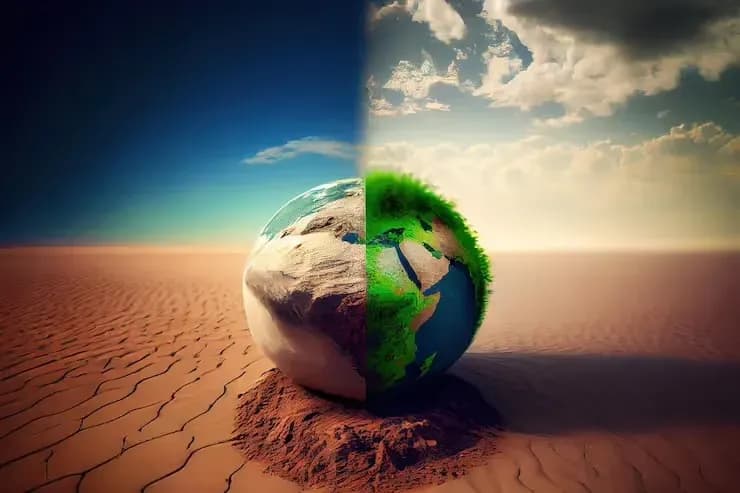
Climate change is one of the greatest challenges humanity is facing. From extreme weather changes to rising sea levels, the impact of climate change is profoundly affecting every aspect of life. Particularly, agriculture and industries dependent on natural conditions are suffering significant damages, requiring timely adaptation and response from nations and communities.
Climate change, manifested by global warming and rising sea levels, has created the current extreme weather phenomena. This is one of the biggest challenges facing humanity in the 21st century because climate change is directly affecting ecosystems, environmental resources and human lives.
Climate change is a term used to refer to changes in climate due mainly to human impacts that change the components of the earth's atmosphere. This change combined with natural fluctuating factors leads to changes in climate over time. To put it simply, climate change is a change in the climate system from the biosphere, atmosphere, hydropower to lithosphere in the present and the future.
Global climate change comes from two groups: objective causes and subjective causes.
According to research by scientists, human impacts on the natural environment are the cause of climate change. Accordingly, the increase in CO2 due to industrial production, deforestation, water use as well as other toxic gases are the cause of the above situation.
In addition, objective factors including changes in nature itself, including changes in solar activity, the earth's orbit, the movement of continents... also have an impact. no small cause of this situation.
Temperatures are getting higher and higher on earth, causing sea levels to gradually rise. Rising temperatures cause glaciers, sea ice or ice continents on Earth to melt and increase the amount of water flowing into the seas and oceans.
Icebergs and glaciers are shrinking. Vast tundras that were once covered by a very thick layer of permafrost are now covered with trees. As an example, the Himalayan glaciers that supply fresh water to the Ganges River – the source of drinking and farming water for about 500 million people – are shrinking about 37 meters per year.
Coastlines are disappearing. Miami's beaches are among many other areas around the world threatened by rising sea levels.
Scientists have conducted observations, measurements and found that the ice on the Greenland ice island has lost a large amount of ice, directly affecting island nations or coastal countries. According to estimates, if the ice continues to melt, sea levels will rise by at least 6 meters by 2100. At this level, most of Indonesia's islands, and many other coastal cities, will completely disappear.
Changes in climate conditions and rapid increases in carbon dioxide levels have seriously affected ecosystems, fresh water supplies, air, fuels, clean energy, food and health.
Under the influence of temperature, air and melting ice, the number of coral reefs tends to decrease. This shows that both terrestrial and aquatic ecosystems are suffering from impacts from floods, droughts, forest fires, as well as ocean acidification.
Current global temperatures are causing species to disappear or be at risk of extinction. About 50% of plant and animal species will face the risk of extinction by 2050 if the earth's temperature increases another 1.1 to 6.4 degrees Celsius. This loss is due to loss of habitat due to fallow land, deforestation and warming ocean waters. Biologists have found that some animal species have migrated to the polar regions to find habitats with suitable temperatures. For example, red foxes used to live in North America but have now moved to the Arctic region.
Humans are also not outside the scope of influence. Falling land and rising sea levels also threaten our habitat. And when plants and animals are lost, our sources of food, fuel and income are also lost.
Food and fresh water are increasingly scarce, land is gradually disappearing but the population continues to increase; These are the factors that cause conflicts and wars between countries and territories.
Due to global warming and climate change, natural resources are gradually depleted. A typical conflict driven by climate change is in Darfur. The conflict here broke out during a long drought, for 20 years the region had only a trickle of rain and even many years without rain, causing temperatures to rise even more.
According to analysis by experts, countries that often suffer from water scarcity and crop failures are often very unstable in terms of security.
The conflict in Darfur (Sudan) occurred partly due to the stresses of climate change.
Increasing temperatures combined with floods and droughts are becoming a threat to global population health. Because this is the ideal habitat for mosquitoes, parasites, rats and many other disease-carrying creatures to thrive.
The WHO reports that dangerous diseases are spreading in more parts of the world than ever before. Areas that previously had cold climates now also have tropical diseases.
Every year, about 150,000 people die from diseases related to climate change, from heart disease caused by rising temperatures, to respiratory problems and diarrhea.
While some parts of the world are inundated with constant floods, others are suffering from prolonged, severe droughts. Droughts deplete domestic and irrigation water sources, seriously affecting the agriculture of many countries. As a result, food production and supply are threatened, and a large number of the earth's population are and will suffer from hunger and thirst.
Currently, regions such as India, Pakistan, and Africa are suffering from droughts, rainfall in these areas is increasingly low, and this situation will continue for the next few decades. According to estimates, by 2020, about 75 million to 250 million Africans will lack water for daily life and farming, leading to a decrease in agricultural output on the continent by about 50%.
Extreme heat waves are happening about four times more often than before, and it is predicted that within the next 40 years, they will be 100 times more frequent than today.
The consequences of these heat waves are the risk of forest fires, diseases caused by high temperatures, and of course contributing to the increase in the average temperature of the earth.
Statistics show that i just the last 30 years, strong level 4 and level 5 storms have doubled.
Warm waters have strengthened storms. It is the high heat levels in the ocean and in the atmosphere that push the storm's speed to terrifying levels.
Warmer water temperatures in seas and oceans are a factor that strengthens storms. Severe storms are becoming more frequent. In just the past 30 years, the number of severe thunderstorms has nearly doubled.
Economic losses caused by climate change are also increasing with global temperature. Major storms cause crop failures, costing billions of dollars; In addition, to control epidemics that spread after each storm and flood also requires a huge amount of money. The harsher the climate, the greater the deficit in economies.
Economic losses affect every aspect of life. People have to endure rising food and fuel prices; Governments face a significant decline in profits from tourism and industry, people's urgent need for food and clean water after each storm and flood, and huge costs to clean up the mess. ruins after storms and floods, and border tensions./.
Log in to leave a comment. Log in
Be the first to comment.
Curate
Sign in to curate
React to this story


