Save
Share
Keep reading
authenticated by

Save
Share
Keep reading

Temples
Amidst the golden autumn sunshine and the sound of the Kinh Thay River flowing, pilgrims come to the Ceramic Temple Relic Site to feel the poetic, sacred and quiet beauty of the temple. The heroic historical imprint of the Tran Dynasty and the glorious feats of Tran Khanh Du in defeating the Yuan-Mongol army three times are always present in this ancient temple, creating a sacred mark for the land of Chi Linh, Hai Duong, Vietnam.
Coming to the ancient temple, calm down, light a stick of incense, and review the legend of the deputy general Nhan Hue Vuong Tran Khanh Du. He was an outstanding naval general. According to the book: "Lich Trieu Hien Chuong Loai Chi" by Phan Huy Chu: Tran Khanh Du was from Chi Linh, Hai Duong province. He was a royal member of the Tran Dynasty, so he was given the title Nhan Hue Vuong Tran Khanh Du. He was born into a family of noble descent, his father was General Tran Pho Duyet, his mother was the first wife Nguyen Thi Mau. Inheriting the royal tradition, from a young age Tran Khanh Du was very passionate about books and was good at military strategy.
He was the one who made many great contributions in the resistance wars against the Yuan-Mongol army in the 13th century. In 1258, the first Yuan-Mongol resistance war broke out, in the strategic battle at Dong Bo Dau, the young general Tran Khanh Du, with his creative intelligence, made a surprise attack on the enemy camp and won a great victory. After this battle, the Yuan-Mongol army was repelled from the Capital and had to withdraw their troops. In the early spring of the year Mau Ngo (1258), at the spring court ceremony to celebrate the achievements and reward the generals, Tran Khanh Du was praised by the king as a man of wisdom and strategy and was given the title of Emperor of the Righteous South. Shortly after, Tran Khanh Du was trusted by the king to suppress the Man rebels, who plotted to rebel in the mountains to overthrow the Tran dynasty. After returning victorious, he was especially loved by the Tran king and awarded the title of "Phieu Ky Dai Tuong Quan".
Some time later, due to his crime, he was dismissed from his position by the court and returned to his hometown to work as a boatman selling coal. In November 1282, preparing for the second resistance war against the Yuan-Mongol, King Tran held a conference in Binh Than to get opinions from the princes and mandarins to discuss plans for attack and defense against the enemy. On this occasion, King Tran happened to meet Tran Khanh Du rowing a boat carrying coal across Nhan Loan wharf in a "conical hat and raincoat". The King invited Tran Khanh Du to attend and discuss plans to defend the country. At the conference in Binh Than, Tran Khanh Du proved to be a resourceful person, offering many profound battle plans that were in line with the King's wishes, and Tran Thai Tong promoted him to the position of Deputy General of the Army. After defeating the enemy, he was again awarded the title of Marquis.
In 1288, during the third resistance war against the Yuan-Mongol, Tran Khanh Du was assigned by Tran Hung Dao to fight a decisive battle at sea. Here, Tran Khanh Du won the battle of Van Don, destroying more than 500 supply ships of Truong Van Ho. The victory in Van Don defeated the Yuan-Mongol army's logistical plan from the beginning, contributing significantly to the early and victorious end of the third resistance war against the Yuan-Mongol.
Tran Khanh Du was not only a talented person, leading troops into battle, but he also had a special ability in training soldiers and thoroughly understood Tran Hung Dao's military strategy. When Tran Hung Dao wrote the book: "Van Kiep Tong Bi Truyen Thu" to train soldiers, it was Tran Khang Du who wrote the preface about the use of military strategy, demonstrating his talent in strategy: "In all matters of using soldiers, if you are good at it, you don't need to arrange battle formations, if you are good at arranging battle formations, you don't need to fight, if you are good at fighting, you won't lose, if you don't lose, you won't die". With his great contributions during the three resistance wars against the Yuan-Mongol, Tran Khanh Du was awarded the title of Nhan Hue Vuong by King Tran.
The country was at peace, Tran Khanh Du returned to live the last years of his life in Thai Ap, on the banks of Tran Xa (in Chi Linh, Hai Duong). On August 15, 1339, Nhan Hue Vuong Tran Khanh Du passed away. In recognition of his contributions, the local people built a temple at the entrance of Gom village, named "Nhan Hue Vuong Tu".
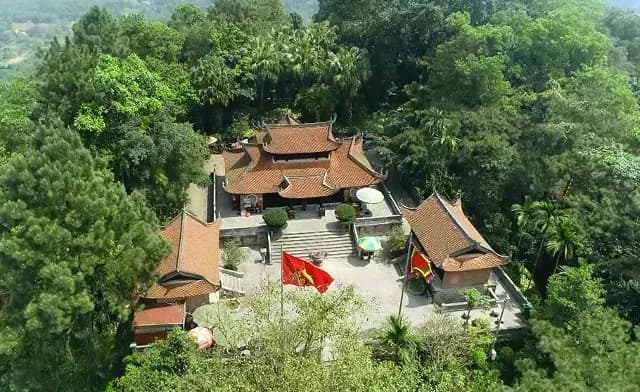
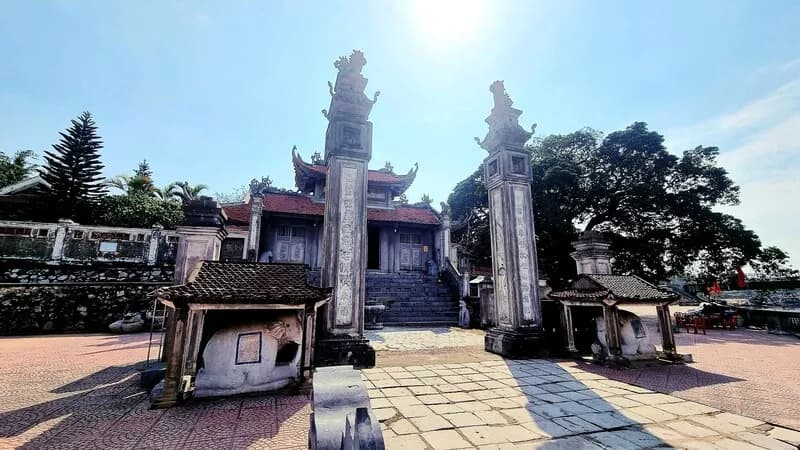
Passing through the three-door gate to enter the main worship area, visitors can admire an ancient scene with the artistic characteristics of the Nguyen Dynasty, along with statues of civil and military mandarins and two ladies (ie two princesses of the Tran Dynasty). Deep inside the harem is the most majestic and sacred place in the temple, we are overwhelmed by an ancient book determined to be from the Nguyen Dynasty, the book is made of wood, painted with red and gold tin and has the words: "vong nhu van".
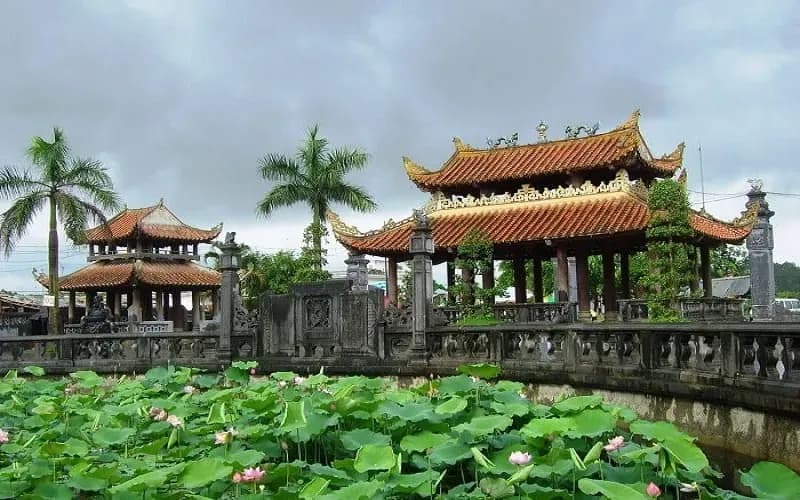
Located in the middle of the harem, the highest altar is the statue of Tran Khanh Du, sitting on the throne, on the left and right are the statues of General Tran Pho Duyet, his wife Nguyen Thi Mau, and Tran Khanh Du's father and parents. On the other side of the dike is Thuy Temple (also known as the Presentation Temple) which reflects itself on Kinh Thay River. The temple worships the water god, and is considered the place to present before visitors enter the main temple. After many years of destruction by the French, Thuy Temple has now been restored by the People's Committee of Chi Linh City.
The temple is designed in the style of an ancient temple, with 8 curved roofs painted with dragon and phoenix shapes on the reinforced concrete floor, ensuring water flow during the rainy season. Thuy Temple with construction items: Thuy Temple, bridge, steps up and down made of solid green stone, embankment construction items on both sides, concrete fences for planting flowers and ornamental plants... Visitors coming here can not only offer incense and pay respect to the saints and predecessors, but also have a place to rest and enjoy the charming river scenery.
Coming to Chi Linh in the autumn of August, tourists cannot miss visiting the Pottery Temple and participating in the temple festival held on the 13th - 21st of the eighth lunar month every year. From Con Son - Kiep Bac to the relic and festival of the Pottery Temple, the most wonderful pilgrimage route is from National Highway 37 in the southwest direction of National Highway 18 about 10km, in addition, tourists from Bac Ninh or Hai Phong can also go by waterway on the Thai Binh River, Kinh Thay River.
At the festival, in addition to the ceremonies, visitors will have the opportunity to learn about the customs and practices imbued with the cultural identity of the people of the Northern Delta through traditional games such as wrestling, tug of war, cockfighting and cultural and sports exchanges... With its spiritual significance and prime location along with the natural scenery imbued with the nuances of the Northern Delta countryside, the Gom Temple relic site, combined with the Con Son - Kiep Bac Autumn Festival, has become an extremely unique spiritual tour, meeting the needs of many visitors on their journey to explore the ancient land of Chi Linh.
Thank you for choosing iguide.ai to accompany your exciting experience!
Log in to leave a comment. Log in
Be the first to comment.
React to this story
Curate
Sign in to curate